Accredited body — Brussels-Capital Region

EPC Certificate in Brussels

Anyone selling or renting a property in Brussels must have a valid EPC certificate. This document assesses the energy performance of the home and must be available from the moment the property is put on the market.
Order my EPC certificate 02 880 21 71
  • Official accreditation

    Brussels Environment

  • +50 000

    Certificates issued

  • Visit within 48h

    Fast turnaround guaranteed

In Brussels — get your energy performance certificate with Certinergie, Belgium’s leading certification provider.
Transactions covered

When is the EPC certificate mandatory?

The EPC certificate must be available from the moment the property is put on the market, i.e. BEFORE the transaction is concluded.

EPC certificate required

  • Sale

    Private sales (including partial), forced or voluntary public auctions, exchanges

  • Rental

    Any letting of an individual dwelling

  • Lease assignment

    Transfer of lease to a new tenant

  • Real estate leasing

    Conclusion of a real estate leasing contract

  • Real rights

    Transfer or creation of a real right for consideration (bare ownership, emphyteusis)

Exceptions (not required)

  • Expropriation
  • Succession
  • Contribution to a company
  • Easements
  • Partition or equivalent deed
  • Mortgage establishment
  • Marriage contracts and amendments
  • Donation

In case of doubt about the type of deed, contact your notary or the consultation service of the Royal Federation of Belgian Notaries.

Important point

The intentions of a potential future buyer regarding the fate of the property do not affect the need to establish an EPC certificate. Even if the buyer wishes to demolish the dwelling or change its use, an EPC certificate will be required if the dwelling falls within the scope.

Fast service within 48h · Official accreditation

Scope of application

Is the property covered by the EPC?

A property falls within the scope of EPC certification if it meets the definition of an “EPC unit” with “individual dwelling” use.

What is an "EPC unit"?

An EPC unit is legally defined as a “set of premises within the same protected volume, designed or modified to be used separately and meeting the definition of a use“.

The protected volume
The protected volume corresponds to the volume of spaces in which energy is used. It includes heated or cooled spaces (continuously or intermittently) as well as unheated spaces not separated from heated spaces by an insulated wall.

Private character

The private character of the premises must be guaranteed by doors with functioning locks for all private rooms accessible from outside or common areas.

Absence of heating

The partial or total absence of a heating system is not sufficient reason to exclude a property from the scope. In this case, the certification procedure uses default values.

Non-residential premises

The absence of doors with locks between the dwelling rooms and non-residential premises (e.g. a shop) does not compromise the private character of the dwelling rooms. If a dwelling is not separated from a non-residential unit by doors with functioning locks, it must still be certified.

Legal definition

What is an “individual dwelling”?

An EPC unit with “individual dwelling” use must meet the following 4 cumulative conditions:

01

Surface area ≥ 18 m²

Usable floor area (carpet area) of at least 18 m²

02

Private toilet

At least one private toilet (for exclusive use of occupants) or connection point in a dedicated room

03

Private bathroom/shower

At least one private bathroom or shower room, or connection to pipework

04

Private kitchen or kitchenette

Own private space with sink and equipment allowing cooking (electric or gas sockets)

Private use mandatory

Private use of these rooms must be guaranteed by one or more doors with functioning locks for all rooms accessible from outside or common areas. Neither dilapidation, unsanitary conditions, nor difficult access to a property determine the obligation to have an EPC certificate established.

Examples of properties excluded from the scope

  • 17 m² studio

    Surface area below 18 m² (condition no. 1)

  • Flat with shared toilet on landing

    No private toilet (condition no. 2)

  • Dwelling with shared bathroom without lock

    Private character not guaranteed (condition no. 3)

  • 20 m² student room with shared kitchen

    No private kitchen (condition no. 4)

  • Dwelling with missing facade parts

    Impossible to define a protected volume

  • Dwelling whose roof has completely disappeared (fire)

    Impossible to define a protected volume

  • Inaccessible property (walled-up openings or under seal)

    Impossible to visit and identify an EPC unit

  • Cleared dwelling with all pipework removed

    Does not have minimum connections

Special cases

  • A property sold as a shell (CASCO) with minimum connections meets the definition of an individual dwelling.
  • A house whose fitted kitchen has been removed remains an individual dwelling (the connections are still present).
Certificate content

What does the Brussels EPC certificate contain?

The EPC certificate allows dwellings to be compared with each other through a standardised calculation, independent of occupant behaviour.

Energy class

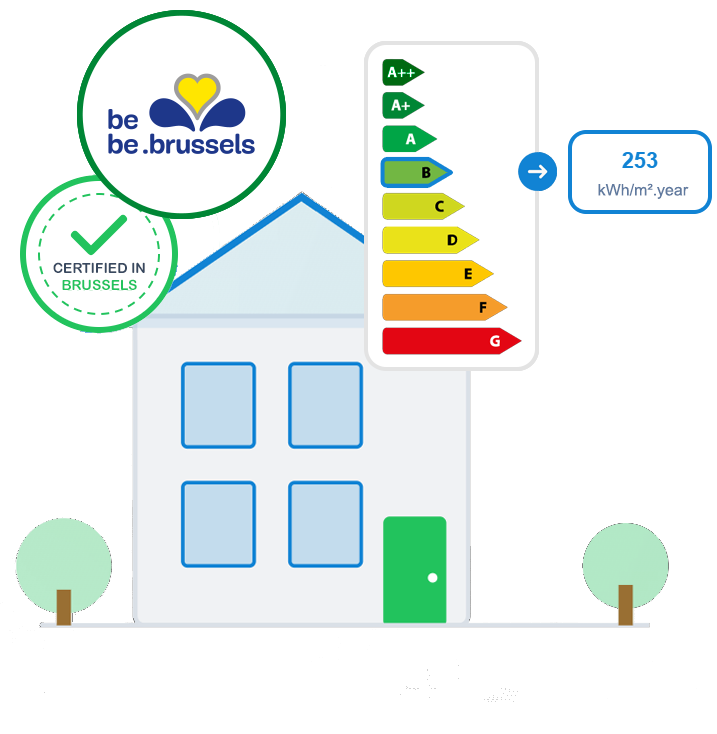
From A (very efficient) to G (very energy-intensive), based on theoretical consumption in kWh/m²/yr

Theoretical consumption

Expressed in primary energy (kWh/m²/yr), calculated on the basis of standardised conditions

CO₂ emissions

Estimate of greenhouse gas emissions linked to energy consumption

Building envelope

Insulation characteristics (roof, walls, floors, glazing)

Technical systems

Performance of heating, hot water production and ventilation installations

Recommendations

List of renovation works to improve energy performance

Brussels energy class scale

Primary energy consumption in kWh/m²/yr

Very efficient

A≤ 45
2020 PEB requirement level for new-build dwellings

B46 – 95

C96 – 150

D151 – 210
Average energy performance of dwellings in the Brussels-Capital Region

E211 – 275

F276 – 345

G> 345

Very energy-intensive
Target Target

Standardised calculation: different from actual consumption

The EPC certificate consumption is calculated on the basis of identical usage conditions for all, which allows properties to be compared objectively. This theoretical consumption may differ from your actual consumption depending on:

  • Thermal comfort: assumption of 18°C on average
  • Occupation: dwelling used 365 days/yr
  • Climate: average climatic year (RMI)
  • Hot water: consumption calculated according to size

Brussels EPC objectives timeline

2025
Today
Beginning of the mandatory energy transition
2033
E
EPC Objective 275
All dwellings: max 275 kWh/m²/yr
Mandatory deadline
2040
C
Public housing
Public housing operators: objective 150
Public sector
2045
C
EPC Objective 150
All dwellings: max 150 kWh/m²/yr
Final objective

Progress towards carbon neutrality

2025

2033

2040

2045

Note : The EPC certificate indicates whether the dwelling meets these objectives and proposes a renovation scenario with the works to be carried out to achieve them.

Discover your energy class and recommendations for improvement

Official document decoded

Understanding your Brussels EPC certificate

Each zone of the official certificate contains essential information. Discover how to read and interpret this document to better value your property.

Official document — Brussels-Capital Region

Key zones of the certificate

Unique EPC certificate number and expiry date. The certificate is valid for 10 years but can be updated after energy renovation works.

Full address, property type (single-family house, apartment) and gross surface area in m². This zone precisely identifies the certified EPC unit and its validity (10 years).

An exterior photo of the building.

The official Brussels scale. From A (≤45 kWh/m²/yr) very efficient to G (>345 kWh/m²/yr) very energy-intensive. The certificate also indicates the 2020 PEB requirement level for new-build dwellings (class A).

Indication of the presence or absence of renewable energy production means: photovoltaic panels (HP), cogeneration (CHP), solar thermal. These installations reduce primary consumption.

The annual carbon footprint of the dwelling in kg CO₂/m²/yr. This environmental data indicates the climate impact of the property, from ‘little’ to ‘a lot’ of emissions.

Expressed in kWh/m²/yr (specific) and kWh/yr (total). This value represents theoretical consumption calculated according to standardised conditions, allowing objective comparison between properties.

The gross floor area corresponds to the total surface area of the building measured based on the external dimensions of the walls, including all covered spaces, whether habitable or not (cellars, attics, circulation areas, etc.).

The contact details of the approved certifier (existing building) or the EPC manager (new building). Their signature is mandatory and guarantees compliance with a very specific procedure.

The importance of supporting documents

Without documentation, the certifier applies penalising default values. For example, wall insulation without proof will be considered absent, which can drop your energy class by several levels.

EPC heating attestations
Work invoices
Technical data sheets
Subsidy proofs
Certifier visit

EPC certification process

The certifier is required to visit the dwelling to record all data influencing its energy performance.

Visual inspection

Certain elements are observed visually by the certifier:

  • Roof type
  • Number of facades
  • Presence of double glazing
  • Window frame type

Evidence-based inspection

Non-visible elements require supporting evidence:

  • Wall insulation
  • Insulant thickness and type
  • Boiler efficiency
  • Glazing performance

Impact of documents on certificate result

Without documents

Unfavourable default values applied

EPC F

With documents

Real data valued

EPC C-

Documents to gather for the visit

Go through this list and gather as many documents as possible: the certifier will sort them.

General data

  • Authentic sales deed
  • Cadastral extract or cadastral income notification
  • Planning permission
  • Basic deed / title deed (co-ownership)

Construction/renovation works

  • Work specifications
  • Technical data sheets of materials (insulation, windows, etc.)
  • Work invoices with precise description
  • Proof of subsidy or tax credit granting
  • Plans and execution details
  • Subsequent intervention file (DIU)

Heating/DHW systems

  • EPC periodic control attestation
  • EPC reception attestation
  • EPC diagnostic report
  • Installation logbook

Renewable energies

  • Conformity attestation (cogeneration, solar PV)
  • Green certificates

Other

  • Energy audit report
  • Blower door test
  • Site photo file

Destructive analysis

In the absence of acceptable evidence, destructive analysis (e.g. making a hole to check the presence, type and thickness of insulation) is permitted if the owner agrees in writing.

Gather your documents, we take care of the rest

Brussels-specific feature

Heating EPC

The certifier must rely on the “Heating EPC” regulation attestations to describe the heating system.

EPC periodic control attestation

Every year (oil) or 2 years (gas)

EPC reception attestation

After replacement or commissioning of a boiler

EPC diagnostic report

Every 5 years for type 2 systems

The logbook

For co-ownerships, the logbook contains the technical sheets, maintenance sheets and periodic control attestations. These documents allow the certifier to establish an EPC certificate reflecting the actual energy reality of the apartment.

Visit within 48h · Official accreditation Brussels Environment

Co-ownerships

Property managers and co-owners

In a co-ownership, collaboration between the property manager, co-owners and the EPC certifier is essential to obtain a certificate reflecting the actual energy reality of the property.

Mandatory access to the boiler room

The EPC certifier must absolutely have access to the boiler room (if it exists) to establish the EPC certificate. Without this access, they cannot record the characteristics of the collective heating system, which severely penalises the certificate result.

Our advice: Prepare a complete EPC file with all documents relating to the boiler room. This way, you won’t have to travel for each certification or hand over the boiler room keys to the certifier. The file allows for faster and more accurate certification.

Role of the property manager

The property manager manages the common technical installations and keeps documents relating to works. They must gather these documents in a space accessible to co-owners and EPC certifiers.

  • Time saved for each certification
  • Consistent recommendations at GA
  • Valorisation of common assets

Reference EPC file

Documents to gather to facilitate certifications:

  • Basic deed with typical floor plans
  • Invoices relating to insulation (walls, roof, cellars)
  • Logbook of the collective heating/DHW installation
  • EPC periodic control and reception attestations
  • Technical data sheets of equipment (boiler, burner)
  • Minutes of general assemblies relating to works

Impact on energy class:

G

No boiler room access or documents

D

With complete file

EPC Reform: the unique EPC Expert for co-ownerships

The Brussels EPC reform introduces an obligation for each co-ownership to appoint a unique EPC Expert. This expert will be responsible for:

  • Coordinating the building’s technical data
  • Identifying all EPC units and common area elements
  • Establishing missing EPC certificates
  • Producing a synthesis report with work recommendations

Anticipate now: Preparing a complete EPC file will facilitate the transition to this new system and allow the appointed EPC Expert to work efficiently from day one.

Need support for your co-ownership?

Certinergie supports property managers and co-ownerships in their EPC compliance: compiling the reference file, coordinating certifications, preparing for the reform.

02 880 21 71 contact@certinergie.be
  • Free quote within 24h
  • Accredited expert Brussels & Wallonia
  • +15,000 certificates completed
Advertising obligations

EPC advertising in Brussels

Owner or intermediary obligations:

  • Provide a copy of the EPC certificate to every prospective buyer or tenant upon simple request
  • Communicate the energy class in every advertisement in a clear and understandable manner

Internet

Property websites with dedicated EPC fields

Agency window

Performance level scale recommended

Posters

Classified ads and paper media

Do you need to put a property up for sale or rent? Get your EPC certificate quickly.

Validity

EPC certificate validity

10 years: Validity period of the PEB certificate in Brussels

10 years

Duration of validity of the EPC certificate in Brussels

Recommended update

After energy renovation works to reflect the improvements made to the dwelling.

Works carried out

The certificate no longer represents the current quality of the property after improvement works.

Tip: A new certificate after renovation can increase the value of your property and facilitate its sale or rental.

EPC Reform 2024-2025

Major upcoming changes in Brussels

The Brussels-Capital Region has adopted an ambitious reform to achieve carbon neutrality of the building stock. Here are the main deadlines and obligations to anticipate.

Why this reform?

56%

of GHG emissions in the BCR come from the building sector

27%

of Brussels households in energy poverty

55%

of dwellings in co-ownership (decision-making complexity)

Deadline calendar

March 2024
CoBrACE Ordinance
Adoption of the ordinance amending the Brussels Air, Climate and Energy Management Code
June 2025
Oil ban
Liquid fuel boilers must use only renewable liquid fuels
2030
Zero emission new-build
All new construction must be "zero emission" (0 GHG on site)
2033
Objective 275
All dwellings must achieve ≤275 kWh/m²/yr (minimum class E)
2040
Public housing
Public housing operators' properties ≤150 kWh/m²/yr
2045
Objective 150
All dwellings must achieve ≤150 kWh/m²/yr (minimum class C)

EPC certificate mandatory for all

Within 5 years of the reform coming into force, any holder of a real right over an EPC unit must have a valid EPC certificate, regardless of any transaction.

Performance obligation: The real right holder must meet the EPC requirements. In case of non-compliance, automatic administrative fines apply (€2.5 per kWh/yr of shortfall, minimum €125).

New obligations for co-ownerships

Homeowner Associations (VME) now have specific obligations under the reform:

  • Appoint a unique EPC Expert for the co-ownership
  • Provide the EPC Expert with data, documents and access to premises
  • The Expert coordinates the building’s technical data and gathers supporting documents
  • The Expert identifies all EPC units and common area elements
  • The Expert establishes missing EPC certificates
  • The Expert produces a synthesis report with work recommendations

Enhanced means obligation: The VME can be released from its liability by demonstrating due diligence and absence of fault, even if the EPC requirements are not met in the private lots.

Decarbonisation measures

Since sept. 2021
Ban on installing coal-fired generators

June 2025
Oil ban (except renewable liquid fuel)

January 2025
New construction: renewable heating mandatory (end of gas + oil)

January 2030
Major renovations: renewable heating mandatory

Derogation system

Derogations from EPC requirements may be granted for three reasons:

Technical reason
Technical obstacles preventing finding a solution to meet the requirement

Functional reason
Implementation affects stability, sanitation, safety standards or building operation

Economic reason
Disproportionate costs (>2x normal work costs, or >3x for oil replacement)

Important : A derogation granted for the 275 kWh/m²/yr objective (2033) does not release from the obligation to achieve 150 kWh/m²/yr (2045). The derogation request must be submitted no later than 1 year before the relevant deadline.

Recommendations by priority

Recommended works to improve the energy performance of your property, ranked by order of impact on your EPC certificate.

1

Roof insulation
Insulation of attics or flat roof with at least 20cm of high-performance insulation

– 45 kWh/m².yr
estimated saving

High

2

Facade insulation
Insulation of exterior walls inside or outside (min. 12cm)

– 40 kWh/m².yr
estimated saving

High

3

Floor insulation
Insulation of ground floor over cellar, ventilated crawl space or solid ground

– 25 kWh/m².yr
estimated saving

Medium

4

Boiler replacement
Installation of a condensing boiler or heat pump

– 35 kWh/m².yr
estimated saving

High

5

High-performance double glazing
Replacement of frames with high-performance double glazing

– 20 kWh/m².yr
estimated saving

Medium

Good to know

These gains are average estimates. The actual impact depends on the specific characteristics of your property. A personalised energy audit allows these projections to be refined.

Receive your personalised recommendations

Why choose Certinergiein Brussels?

A trusted body for your energy certification

Recommanded

Accredited body

Official accreditation Brussels Environment

Mastered protocol

Expertise in the Brussels EPC protocol

Co-ownership experience

Support for property managers and co-owners

Reliable reports

Compliant and accurate certificates

Recognised by professionals

Notaries and estate agencies

Fast intervention

Availability within 48h

+50 000

Certificates

48h

Average lead time

15+

Years of experience

100%

Compliant

Frequently asked questions

The EPC certificate must be available from the moment the property is put on the market, i.e. BEFORE the transaction is concluded. To avoid publishing an advertisement in breach of regulations, it is best to act as early as possible.

Each individual dwelling EPC unit subject to a transaction must have its own EPC certificate. If the building contains several EPC units, there will be as many certificates as units.

No, the partial or total absence of a heating system is not a sufficient reason to exclude a property from the scope. The procedure uses default values.

By 2033, all dwellings must achieve a maximum of 275 kWh/m²/yr (class E). By 2045, the objective is set at 150 kWh/m²/yr (class C).

Gather as many documents (invoices, technical data sheets, subsidies) as possible before the visit. Documented information will in most cases have a positive impact on the result.

Get your EPC certificate in Brussels

Accredited body, fast intervention, certificate compliant with Brussels regulations.

Order my EPC 02 880 21 71

© Certinergie NPO – VZW rue Haute Voie 5 4537 Verlaine / Chaussée de Tirlemont 156, 5030 Gembloux / Brusselsesteenweg 599,3090 Overijse / Avenue Louise 367 1050 Bruxelles RPM ASBL 0536.501.654. RPM SRL 0831.937.722. Certinergie Luxembourg SARL