Accredited body – Accreditation 563-INSP
Periodic electrical inspection
Is your installation over 25 years old? Does your business need to renew its inspection?
+50 000
inspections performed
Is your installation over 25 years old? Does your business need to renew its inspection?
The natural ageing of electrical installations creates invisible risks. The RGIE (Part 6, Chapter 6.5) imposes regular inspection visits to protect occupants.
in Belgium are of electrical origin. Ageing of cables and connections is often the cause.
of installations inspected during a sale show at least one RGIE infringement.
Insulation degrades, connections loosen, standards evolve. Regular inspection protects.
In the event of an electrical incident (fire, electrocution), the absence of a valid periodic inspection report may engage your liability and lead to a coverage refusal by your insurer.
The frequency depends on the type of installation and its use (RGIE Chapter 6.5, Section 6.5.2).
Good to know: The inspection during a sale resets the counter to zero. If your last report dates from the sale, count 25 years from that date.
Some installations: explosion-risk zones, hospitals, high-traffic establishments may require annual inspection
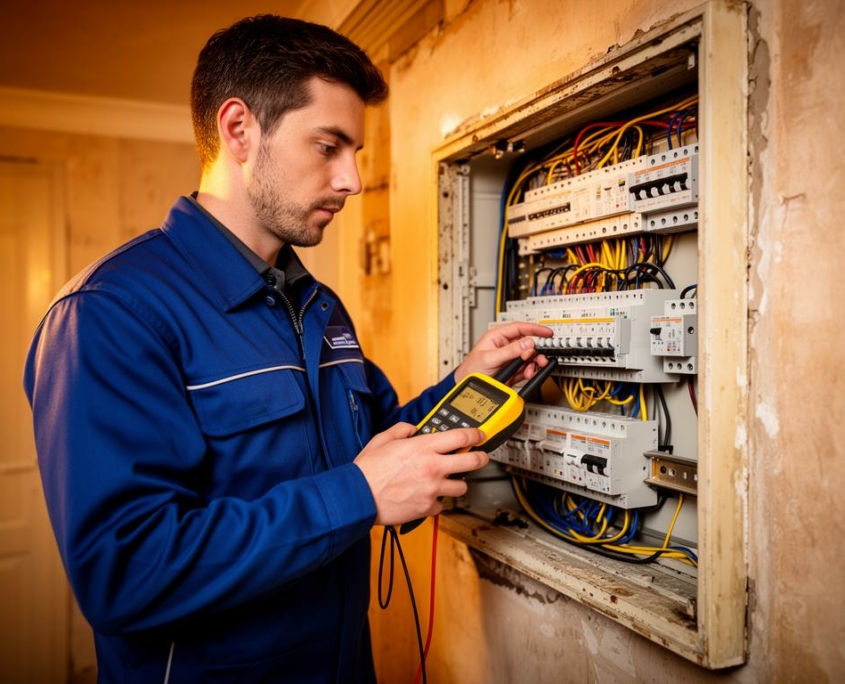
The periodic inspection visit follows the RGIE protocol (sections 6.5.3 to 6.5.6) and comprises four complementary aspects:
Administrative checks
Verification of the installation file: previous reports, up-to-date single-line diagrams, position plans, technical documentation, modification history.
Visual checks
Inspection of the condition of cables, connections, protective devices. Detection of overheating signs, degradation, non-compliance of routing methods.
Functional tests
Testing of residual current devices (30mA), verification of the operation of cut-off and protective devices.
Technical measurements
Insulation resistance of circuits, earth connection dispersion resistance, continuity of protective conductors, loop impedance.


Compliance deadline: For domestic installations, the deadline is 12 months from the inspection date for post-1981 installations, and 18 months from the deed date for pre-1981 installations never previously inspected (in the context of a sale).
Flat-rate pricing, no surprises. Digital report sent instantly after the inspection.
Inspection report established by an accredited body. Valid for 25 years if compliant (domestic).
Insulation values, earth resistance, RCD testing – complete technical data.
Comparison with previous reports to identify progressive degradation.
Report sent by email as soon as the inspection is finished. Copy kept by the body for 5 years.
Accredited by the Federal Public Service Economy (563-INSP). Reports recognised by all administrations and insurers.
Don’t let an overdue inspection drag on. We intervene quickly, including in emergencies.
Wallonia, Brussels and Flanders. Regional inspector network for maximum proximity.
How do I know when my next inspection is due?
Check your last electrical inspection report: the date of the next inspection is indicated. For a domestic installation, add 25 years to the date of the last compliant report. For a non-domestic installation, add 5 years. If you no longer have the report, contact us to check.
What is the difference between a periodic inspection and a sale inspection?
The sale inspection is actually an inspection visit (RGIE 6.5) carried out in the context of a property transaction. It counts as a periodic inspection and resets the validity counter to zero. Outside of a sale, the periodic inspection has exactly the same technical content.
My installation was inspected less than 25 years ago but I have done work. Do I need a new inspection?
If the work constitutes a major modification (additional circuit, PV installation, non-identical panel replacement), a conformity inspection is mandatory for that specific modification. The overall periodic inspection remains valid until its expiry. See our conformity inspection page for details.
What are the risks if the periodic inspection is not done on time?
No automatic criminal penalty, but significant risks: your insurance may refuse to intervene in the event of an electrical incident. Furthermore, in the event of an accident involving a third party, your civil liability could be engaged. It is a real risk, not a theoretical one.
Do I need to provide single-line diagrams for the periodic inspection?
Diagrams are part of the electrical installation file and must be presented at every inspection visit. If they are missing or out of date, this will constitute an infringement in the report. For post-1981 installations, Certinergie does not charge extra for producing sketches.
How long does a periodic inspection take?
For a standard domestic installation (1 meter, up to 2 panels), allow approximately 1h to 1h30. For non-domestic installations, the duration varies according to size and complexity – we will inform you when booking the appointment.
Can the installation be cut off during the inspection?
The inspection requires the installation to be energised to carry out measurements and tests. Some tests (RCD testing) cause a very brief cut-off. The inspector warns you before each test likely to cut the supply.
Is the periodic inspection the same for all businesses?
The base periodicity is 5 years for non-domestic installations, but some installations require more frequent inspections: explosion-risk zones (annual), hospitals, high-traffic establishments. The inspection scope is adapted to the type of activity.
Don’t take any risks. Order online, intervention within 48h, instant report.