Certified energy experts · Flemish Region

EPC certificate in Flanders : delivered quickly by a certified expert

In Flanders, the Energy Performance Certificate (EPC) is the equivalent of the PEB certificate. It is mandatory as soon as a home is advertised for sale or rent. Our Type A energy experts visit your property, take your supporting documents into account and issue your EPC. Valid for 10 years, from €165 incl. VAT.

  • On-site inspection required
  • Valid for 10 years
  • Supporting documents taken into account
  • Training centre for energy assessors
Order an EPC 02 880 21 71

Updated on 18 October 2026 · Sources: Brussels Environment, Renolution, Belgian Official Gazette
What changes in 2026?

Since 1 January 2026

Renovation requirement: 6 years instead of 5 to achieve label D, including for purchases made since 2023. Find out more

2028 tightening: cancellation announced

The C label planned for purchases from 2028 is expected to be dropped. The official amendment is still pending. Details

Since 1 March 2026

Mijn VerbouwPremie: the two highest income categories are now eligible only for the heat pump grant. View grants

From 2030 (announced)

A minimum energy performance standard will apply to rental properties.

Transactions concerned

When is an EPC mandatory in Flanders?

An EPC must be available before the property is first advertised. Wording such as “EPC pending” or “aangevraagd” is not permitted.

Sale of a home

Required as soon as the property is advertised. The original is handed over to the buyer when the notarial deed is signed. It must remain valid until that date.

Rental of a home

Required as soon as the property is advertised. A copy is attached to the lease; the landlord keeps the original.

Common parts (EPC GD)

Mandatory for every building with at least two residential units, regardless of whether a transaction takes place.

Small non-residential units (EPC kNR)

Shops, offices and business premises under 500 m², when sold or rented.

Exemptions

  • Private sale or rental with no written advertising whatsoever
  • Uninhabitable property, houseboat
  • Holiday rental for less than 2 months (unless it is the tenant’s main residence)
  • Sale of only part of a property
  • A home no more than 10 years old with a valid EPC Bouw : this certificate is used instead
Scope of application

Which type of EPC do you need?

Most common

Residential EPC

  • Houses and apartments
  • Labels A+ to F
  • Sales and rentals
Co-owned buildings

EPC for common parts (GD)

  • Buildings with 2 or more residential units
  • Required even without a transaction
  • Must be renewed within 6 months if more than 15% of the building envelope is renovated or shared technical systems change
< 500 m²

EPC for small non-residential units (kNR)

  • Shops, offices and professional practices
  • Specific assessment method
  • Valid for 10 years
For a salethe EPC must have been issued in 2019 or later (version with an energy label). An older EPC may still be used for rentals as long as it is less than 10 years old.
Certificate contents

What does a Flemish EPC contain?

The EPC provides a standardised score for comparing homes across Flanders and indicates how their performance can be improved.

Energy score

Theoretical primary energy consumption, in kWh/m².year.

Energy label A+ to F

A quick overview of the score and how it compares with the 2050 target.

Building envelope

Roof, walls, floors and windows, including their U-values.

Technical systems

Heating, hot water, ventilation and renewable energy.

Recommendations

Priority renovation measures and their estimated impact on the energy label.

Woningpas

The EPC is automatically included in the Woningpas, the digital property passport.

Residential EPC rating scale (kWh/m².year)

A+< 0
A0 – 100
2050 target
B100 – 200
C200 – 300
D300 – 400
minimum after mandatory renovation
E400 – 500

F> 500
EPC score ≠ actual energy bill. The calculation assumes an average temperature of 18°C, year-round occupancy, a standard climate year and hot water consumption based on floor area. It compares homes, not occupants’ habits.
Official document explained

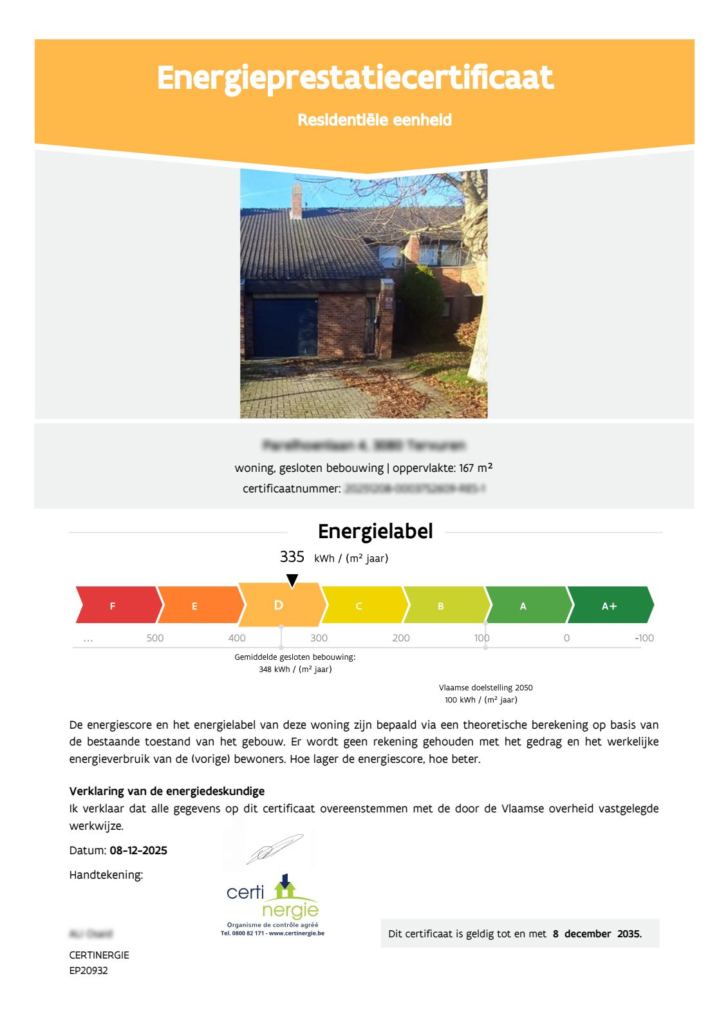
Example of a Flemish EPC certificate

Explore the key sections of an EPC and learn how to understand this official document.

Example - Overview of your EPB certificate in Flanders
Official Flemish Region document

Key sections of the certificate

Full address, building type and unique certificate number for traceability.

Value in kWh/(m².year) showing theoretical consumption. Here, 335 kWh/m².year corresponds to label D on the Flemish scale.

Shows where the property stands on the energy scale. The indicator displays its current performance against the standards.

Refers to the Flemish target of 100 kWh/m².year (label A), which all homes are expected to achieve in pursuit of climate neutrality.

Visual assessment of each element: roof, walls, windows and floors. Coloured icons indicate performance levels.

Details of the systems: heating (type and efficiency), domestic hot water production, ventilation and renewable energy.

List of recommended works and their estimated impact on the score. Helps plan renovations in order of priority.

Tip : Keep your invoices and grant certificates. Without evidence, the energy expert must apply unfavourable default values.
Renovation requirement

Mandatory renovation after buying a property rated E or F

Since 1 January 2023, buyers of homes with an energy label E or F have had to renovate them to at least label D. Since 1 January 2026, they have 6 years from the signing of the notarial deed (instead of 5), including for purchases made since 2023.

Who is affected?

  • Any new owner acquiring a property by notarial deed: purchase, gift, long lease or building rights
  • Second homes are included
  • Evidence: a new EPC before the deadline

The seller must inform the buyer of this requirement, notably in the preliminary sales agreement and the deed.

What if the target is not reached?

  • Administrative fine from VEKA of €500 to €5,000 for a home
  • Paying the fine does not remove the obligation: a new deadline is imposed
  • Exceptions: protected heritage, demolition within the deadline and temporary buildings

Planned tightening after 2028

2023

Purchase of an E/F-rated property → D within 6 years (in force)

2028

→ C cancellation announced

2035

→ B / C cancellation announced

2040

→ A / B cancellation announced

2050

Target: housing stock rated A

Legal status: the 2024–2029 Flemish coalition agreement plans to cancel this tightening and retain label D as the sole requirement. Until the Energiebesluit is amended, the tighter requirements remain in the legislation. If you buy from 2028 onwards, ask your notary to check which rules apply.

Renovation grants and loans in Flanders

Mijn VerbouwPremie

The unified Flemish renovation grant, applied for through Mijn VerbouwLoket. The amount depends on your income category.

  • Since 1 March 2026 : categories 1 and 2 (the highest incomes) are only eligible for grants for heat pumps or heat pump water heaters.
  • Categories 3 and 4: no changes.
  • EPC label grant discontinued (applications accepted until 30 June 2026 for a pre-renovation EPC issued before 2026).

Official eligibility conditions

Mijn VerbouwLening

Low-interest loan, potentially as low as 0% depending on income, for energy-related works. Since 2026: minimum amount €4,000, property connected to the electricity grid before 2006, and the applicant must not own another home.

6% VAT

For renovations to homes more than 10 years old, and for heat pumps (excluding hybrid systems) until 2030.

Validity and how the inspection works

Validity: 10 years

  • Sale: EPC issued in 2019 or later
  • After an extension, the EPC may no longer be valid
  • Recommended after insulation, a new heating system, solar panels or a heat pump to reflect an improved energy label

The expert’s visit

  • Building envelope inspection: roof, walls, floors, windows
  • Inspection of systems: heating, hot water, ventilation and solar
  • Review of your supporting documents
  • Photos submitted to VEKA

No destructive testing: the expert relies on visible or documented evidence. Duration: 45 minutes to 1 hour 30 minutes for a house.

Supporting documents to prepare

  • Detailed invoices showing the property address
  • Energy grant certificates
  • Material specifications
  • Architectural plans
  • Dated construction photos
  • Installation compliance certificates

Advertising, responsibilities and fines

What the advertisement must include

  • The label (A+ to F) or energy score in kWh/m².year, on all media: online, posters, press and estate agency listings
  • Wording such as “EPC pending” or “aangevraagd” is not allowed
Compliant example : “Four-bedroom house in Ghent – Label B – 156 kWh/m².year”

Fines

€500 to €5,000

For a missing EPC or non-compliant advertising. Paying the fine does not remove the obligation to obtain an EPC, and another fine may be imposed during a later inspection.

Party Obligations
Seller EPC before advertising, access to all rooms, supporting documents, handover of the original at signing, information about mandatory renovation if rated E or F

Landlord
Valid EPC before offering the property for rent, label or score in the advertisement, copy attached to the lease
Property manager Arrange an EPC GD, ensure access to the boiler room and provide technical documents
Notary Checks that a valid EPC is available and mentions the renovation requirement in the deed

Why choose Certinergie in Flanders?

French-speaking service

A French-speaking contact for a property in Flanders: ideal for owners based in Brussels or Wallonia.

Type A energy experts

Certified experts trained in the Flemish assessment method who take all your supporting evidence into account.

Co-owned properties

Coordinated EPCs for common areas and individual units for property managers.

Three Regions, one partner

PEB Wallonia · PEB Brussels · Three-Region timetable

Order online

Quick appointments, customer portal and full online tracking.

+215 000
certificates issued

Operating in all three Regions since 2011.

Frequently asked questions about EPCs in Flanders

PEB is the term used in Wallonia and Brussels, while EPC (Energy Performance Certificate) is the Flemish equivalent. Each Region has its own calculation method and rating scale: a Flemish label is not directly comparable with a Walloon or Brussels label.

For a sale, since 2022 the EPC must have been issued in 2019 or later (the version with labels A+ to F). For rentals, an older EPC is still acceptable as long as it is less than 10 years old.

You must renovate the property to at least label D within 6 years of the notarial deed and demonstrate this with a new EPC. On 1 January 2026, the period increased from 5 to 6 years, including for purchases already within the deadline.

The Flemish Government has announced that the planned tightening (label C for deeds from 2028, followed by B and A) will be cancelled. Until the Energiebesluit is amended, however, those stricter requirements remain in the legislation. We will update this page when the official change takes effect.

The expert must apply unfavourable default values. Without invoices, grant certificates or technical specifications, even a properly insulated home may receive a poor rating.

The EPC for common parts (EPC GD) is paid for by the co-owners and commissioned by the property manager. It is mandatory for all buildings containing at least two homes, regardless of whether a sale or rental takes place.

No. An EPC is legally required as soon as a property is advertised. The buyer’s agreement does not change this, and failure to obtain an EPC may result in a fine of €500 to €5,000.

Usually 45 minutes to 1 hour 30 minutes for a single-family house. The expert inspects the building envelope and technical systems and reviews your supporting documents.

Yes. In Flanders, the EPC is automatically added to the Woningpas, the digital property passport.

Need an EPC certificate in Flanders?

Certified experts, French-speaking service and prompt appointments throughout Flanders.

Order an EPC Call us
  • 02 880 21 71
  • info@certinergie.be

© Certinergie NPO – VZW rue Haute Voie 5 4537 Verlaine / Chaussée de Tirlemont 156, 5030 Gembloux / Brusselsesteenweg 599,3090 Overijse / Avenue Louise 367 1050 Bruxelles RPM ASBL 0536.501.654. RPM SRL 0831.937.722. Certinergie Luxembourg SARL